From ABM strategy to activation: building a practical growth programme for Acopia
How spanb2b helped Acopia develop and begin activating a focused account-based marketing programme, designed around its commercial ambitions, target customers and internal capabilities.
- Client
- Acopia
- Sector
- Retail consumables and solutions
- Services
- ABM strategy, go-to-market planning, sales and marketing alignment, ABM activation planning
The challenge
Acopia, a major provider of retail consumables solutions, wanted to accelerate new business growth by building stronger relationships with high-value retail accounts.
Account-based marketing (ABM) offered a significant opportunity to focus sales and marketing efforts on the organisations most likely to deliver commercial value. But moving from ambition to execution required more than identifying target accounts.
The retail sector presents a complex B2B buying environment, with multiple decision-makers, competing commercial priorities, different organisational structures and lengthy sales cycles. An effective ABM programme needed to reflect those realities while remaining practical for Acopia's team to deliver.
With limited internal capacity and specialist ABM expertise, Acopia needed an experienced B2B marketing partner to develop a clear strategy, establish the right foundations and provide a realistic route to activation.
The approach
The right ABM strategy depends as much on the organisation delivering it as the audience it wants to reach. Some businesses need an agency to manage their ABM programmes end to end. Others have capable internal teams but need specialist support to develop the strategy, establish priorities or strengthen execution.
For Acopia, our role was to provide the strategic expertise, commercial direction and practical framework that would enable its existing team to take the programme forward.
We started by building a detailed understanding of Acopia's market, commercial objectives, sales environment and existing marketing capabilities. Combining internal business intelligence with market research, competitor analysis and a review of existing content, we identified where ABM could deliver the greatest value.
This included defining best-fit accounts, understanding the needs of different buying-group stakeholders and identifying the commercial challenges and messages most likely to resonate with retail decision-makers.
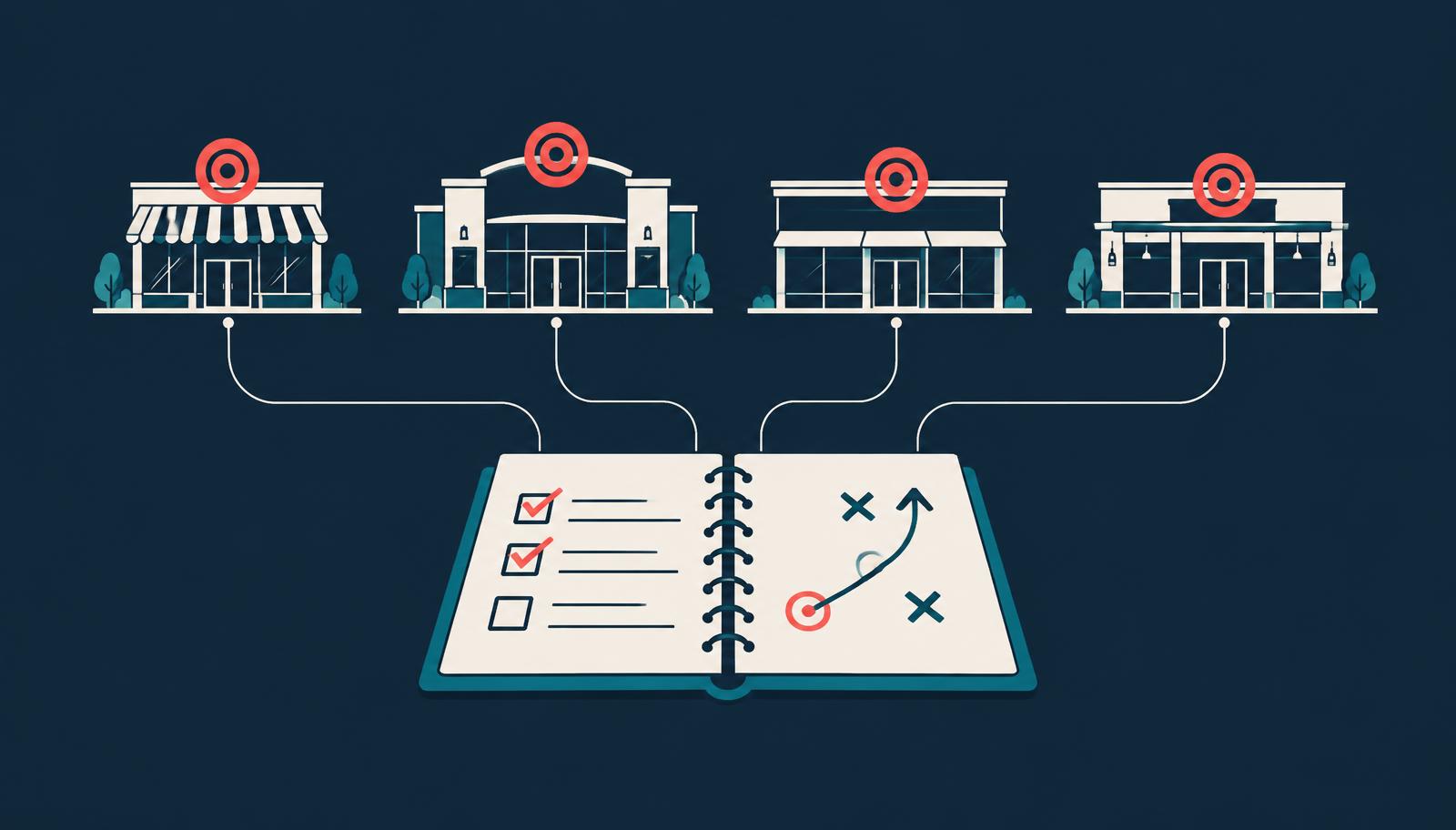
Rather than recommending a large-scale ABM rollout, we prioritised focus, relevance and deliverability. We developed a targeted 1:few ABM pilot centred on a select group of multi-site retailers with shared characteristics and business challenges. This allowed Acopia to concentrate its resources on a manageable number of high-value opportunities, using a consistent proposition that could be adapted to different accounts and buying groups.
To bridge the gap between strategy and execution, we created a comprehensive ABM blueprint and practical activation runbook.
What the runbook established
Account selection and prioritisation
Which retail organisations to target and why.
Buying-group understanding
The stakeholders involved, their priorities and the challenges influencing purchasing decisions.
Messaging and positioning
How to communicate Acopia's value in ways that resonate with different decision-makers.
Content and engagement
The assets, channels and touchpoints needed to support relevant, coordinated account engagement.
Sales and marketing alignment
How teams should collaborate, share intelligence and coordinate activity.
Measurement and optimisation
How to track engagement, assess progress and refine the approach as the programme develops.
Crucially, every recommendation was considered through the lens of Acopia's existing resources, team structure and ability to execute. The objective was not simply to define what good ABM should look like. It was to establish an approach that Acopia could realistically implement, manage and develop over time.
The outcome
Acopia has moved from exploring account-based marketing as a growth opportunity to beginning activation of its first focused 1:few ABM pilot.
With a clear target-account strategy, defined buying-group priorities, tailored messaging and an actionable runbook, the business now has the foundations to coordinate sales and marketing activity around its most valuable retail prospects. The programme has been designed to support both immediate activation and longer-term development, allowing Acopia to build on its initial pilot as the team gains insight and experience.
ABM is a longer-term commercial investment, particularly in sectors with complex buying groups and extended purchasing cycles. With activation underway, pipeline and revenue outcomes are still to be established as the programme progresses.
What Acopia has achieved is an important first step: moving from ABM ambition to a focused, structured programme that its team can put into practice. The result is an account-based marketing approach built around Acopia's commercial opportunity and operational reality, rather than a generic framework that looks good on paper but proves difficult to deliver.
ABM support built around your business
At spanb2b, we recognise that no two businesses need the same level of agency support. Whether that is developing an ABM strategy, helping an internal team bring a programme to market or managing integrated ABM and demand generation campaigns end to end, we shape our involvement around the commercial challenge, existing capabilities and outcomes that matter.
Because a successful ABM programme is not defined by how much an agency delivers. It is defined by whether the approach works for the business it is designed to support.